
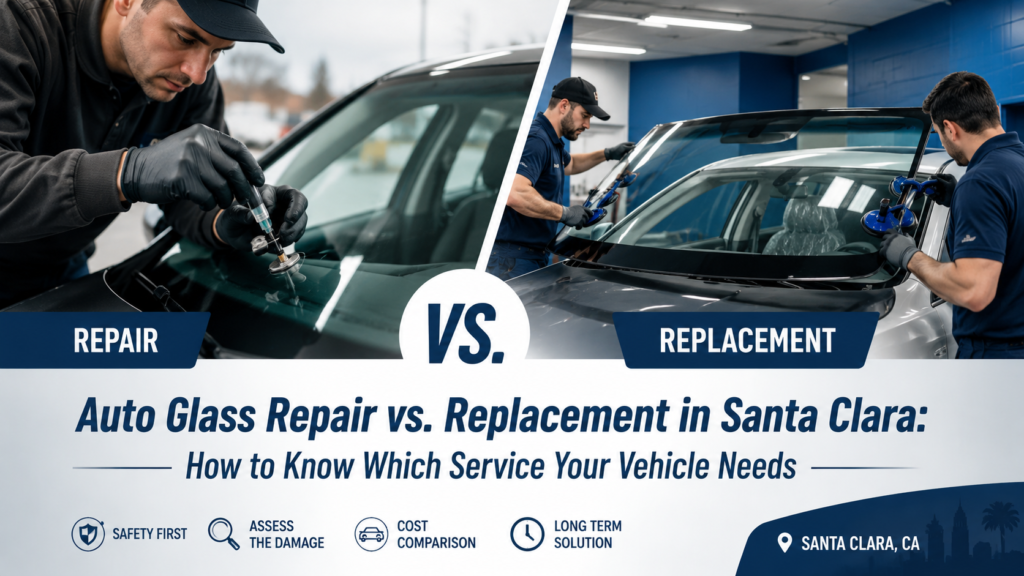
Santa Clara drivers experience windshield damage regularly the combination of Silicon Valley’s busy freeways (Interstate 880, US 101, Highway 237), active construction throughout the city and surrounding communities, and the daily exposure to highway speeds and the trucks that travel them creates consistent windshield chip and crack events. When damage occurs, the immediate question is whether it can be repaired or whether the windshield needs full replacement. This decision matters for both safety and practical reasons: the right call avoids unnecessary expense while the wrong one choosing repair when replacement is needed compromises vehicle safety. This guide explains the factors that determine whether Auto Glass Repair vs Replacement Santa Clara is appropriate for Santa Clara drivers.
Understanding How Windshield Glass Is Constructed
Modern vehicle windshields are laminated glass a safety glass construction consisting of two layers of tempered glass bonded together by a polyvinyl butyral (PVB) interlayer. This laminated structure is what distinguishes windshields from the tempered glass used in side and rear windows. When laminated glass is damaged, it typically cracks or chips without shattering into pieces the PVB interlayer holds the glass together even when both layers are fractured. This characteristic makes certain types of windshield damage repairable.
Side windows and rear windows are made of tempered glass only no interlayer. When tempered glass breaks, it shatters into thousands of small rounded pieces. This means that side and rear window damage can never be repaired; any break requires full glass replacement. The repair-versus-replacement decision only applies to windshields.
Factors That Determine Whether Damage Is Repairable
Size is the primary determinant. Industry guidelines and the practical capabilities of repair resin establish that chips smaller than approximately one inch in diameter and cracks shorter than about three inches are generally candidates for repair. Damage larger than these thresholds particularly cracks that extend across a significant portion of the windshield require replacement because the structural integrity of the glass over the damaged area cannot be adequately restored by resin injection alone.
Damage type affects repairability independent of size. Bullseye chips circular impacts with a clear center and star breaks impacts with radiating arms are generally good repair candidates when within size limits. Combination breaks with multiple fracture patterns can be repaired if the overall extent is limited. Edge cracks cracks that start at or reach the edge of the windshield are generally not repairable even when short. Edge cracks propagate rapidly, weaken the glass-to-frame bond, and compromise the windshield’s structural contribution to the vehicle body.
Depth of penetration determines repairability at the glass layer level. Damage that penetrates only the outer glass layer of the laminated structure is repairable. Damage that penetrates through both glass layers or significantly disrupts the PVB interlayer requires replacement. A technician probes the damage during assessment to determine penetration depth.
Location on the windshield is the fourth key factor. Damage in the driver’s critical viewing area the zone directly in the line of sight through the steering wheel is subject to stricter evaluation because even a quality resin repair leaves some optical variation at the repair site. In California, auto glass standards and officer discretion consider whether damage (or the effect of a repair) in the driver’s direct sightline impairs vision. Some damage in this zone that is technically repairable by size may warrant replacement to ensure completely clear vision.
ADAS sensor compatibility is an increasingly important factor for Santa Clara’s technology-intensive vehicle fleet. Many late-model vehicles in Silicon Valley have windshield-mounted cameras for lane departure warning, automatic emergency braking, and other ADAS features. For these vehicles, the positioning and optical clarity of the glass in the camera zone is critical. Damage in or near the camera mounting area may require replacement even if the damage itself is small, because resin repair may affect the camera’s field of view or calibration.
What the Repair Process Involves
When damage is assessed as repairable, the repair process uses a specialized injector tool and optical-grade resin to fill the chip or crack. The technician begins by cleaning and drying the damage area thoroughly any moisture, dirt, or contaminants remaining in the void will compromise the resin bond. The injector is mounted over the damage point and uses alternating vacuum and pressure cycles to draw air out of the damaged area and force resin in, ensuring the resin penetrates all micro-fractures within the chip or crack.
After injection, the surface is smoothed and a small amount of finishing resin is applied to the pit. The resin is cured under UV light either from a UV lamp or direct sunlight which causes it to harden to a clear, stable state chemically similar to the glass. After curing, the surface is polished. A quality repair reduces or eliminates the visual effect of the chip in normal driving conditions and prevents further propagation of the damage. Most repairs are completed in 20 to 30 minutes.
What the Replacement Process Involves
Full windshield replacement removes the damaged glass and installs a new windshield using urethane adhesive bonding. The technician cuts through the urethane bond with specialized tools, removes the old glass, cleans and prepares the pinch weld frame, applies primer and new urethane adhesive, and sets the new glass in place. Safe drive-away time for modern fast-cure urethane adhesives is typically 30 to 60 minutes, though the adhesive continues to cure and gain strength for 24 to 48 hours.
For Santa Clara vehicles with ADAS cameras mounted to the windshield, replacement requires ADAS recalibration after the new glass is installed. Nearly 90 percent of 2023 and newer model vehicles require calibration. Static calibration uses target boards in a controlled environment. Dynamic calibration involves driving under specific conditions. Some vehicles require both. Without proper recalibration, ADAS systems may malfunction, creating a safety risk rather than the safety benefit these systems provide.
Common Questions About Auto Glass Repair vs. Replacement in Santa Clara
How do I know if my chip can be repaired or needs replacement? General guidelines: chips smaller than a quarter in diameter and cracks shorter than about three inches are candidates for repair. Edge cracks, damage in the driver’s direct sightline, and damage penetrating through both glass layers typically require replacement. A qualified technician’s assessment of the specific damage provides the definitive answer.
Does California insurance cover windshield repair in Santa Clara? Comprehensive insurance covers windshield damage under most California policies. Many California insurers waive the deductible for chip repairs, making prompt repair effectively free. This creates a strong practical incentive to address chips early, before they propagate into cracks that require full replacement with the deductible applied.
If I choose repair and it fails later, what happens? Reputable auto glass services apply the amount paid for the repair toward a full replacement if the repair subsequently fails. This policy removes the financial risk from the repair decision and allows customers to choose the less expensive option when technically appropriate.